Ask most people to describe the relationship between governance and innovation, and you’ll hear the language of conflict. Governance slows innovation down. Innovation breaks the rules governance sets. One is the brake, the other is the accelerator, and every organisation is supposedly stuck choosing between them.
Here’s my view: that framing is wrong. And there’s an old diagram that explains it better than any strategy deck I’ve seen: the yin-yang symbol.
Two Halves of One Circle
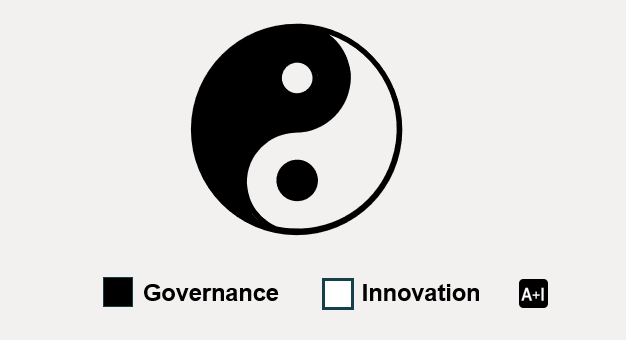
Look at the diagram. Governance is the black half. Innovation is the white half. Neither dominates and neither exists without the other. Together they form a complete circle, and that circle is what a healthy organisation actually looks like.
Take away the black half and you lose control: shadow AI, risk nobody is managing, experiments nobody can trace or repeat. Take away the white half and you lose innovation: you’re left with a well-documented organisation that stopped moving years ago.
So the symbol is not about a 50/50 split. It is about something deeper: each half gives the other its meaning. Governance only matters when there is real innovation to govern, and innovation only compounds when governance makes it safe to scale.
The White Dot: Innovation Inside Governance
Now look closer at the black half. There is a small white dot inside it.
That dot is innovation living inside governance, and the important word is “small”. Your governance function should innovate. It should simplify approval steps, automate compliance checks, and try better ways to watch how AI actually behaves. A governance team that never improves its own methods becomes the very bottleneck everyone complains about.
Here is a real example of that in action. AI-enabled medical software has an awkward property: the model keeps improving. It gets retrained on new data, its thresholds get tuned, its accuracy climbs. Under the traditional rules, each meaningful change to an approved device meant a fresh regulatory submission. It’s a process that can take months, during which patients keep using the older, weaker model. Governance literally slows down the thing that made patients safer.
The US Food and Drug Administration’s answer was not to abandon oversight. It was to innovate its own method. In its December 2024 final guidance, the FDA formalised the Predetermined Change Control Plan: a manufacturer describes up front the changes it expects to make to its AI model and how it will test them, the FDA authorises that plan alongside the device, and future updates that stay inside the plan no longer need a brand-new submission. The control is still there but the approval workflow now moves at the speed of the technology instead of against it. That is the white dot doing its job: governance improving itself so it stops being the bottleneck.
But the dot stays a dot. Governance is not the place for constant change. Its value comes from being stable and predictable. People need to trust that the rules today will still be the rules tomorrow, and if your controls change as fast as the technology they watch over, they stop being controls. A little innovation keeps governance alive. Too much dissolves it.
The Black Dot: Governance Inside Innovation
The white half carries a small black dot of its own.
That dot is governance living inside innovation, and again, the size is the message. Every experiment needs a few basic guardrails: a clear owner, a set boundary, and a way to shut it down if it goes wrong. Innovation with zero governance is not bold, it is just unaccountable.
It is easy to picture what a missing black dot costs you. A team builds a clever AI assistant in a company. It works, so more people start using it. Six months later, nobody can say what data it touched, who approved it, or how to switch it off. That is not innovation. That is a problem waiting to happen, dressed up as innovation.
But keep the dot small. If every pilot needs three committees and a six-week approval cycle, you have not governed innovation, you have buried it. The guardrails should be light enough that a team can move this week, not this quarter: enough governance to make the experiment safe, but not so much that the experiment never happens.
When the Proportions Go Wrong
Most AI failures are not caused by having governance or innovation. They are caused by getting the dots wrong — and there are four ways to do that. It helps to know each one.
- The dot grows too big inside governance. The rules keep shifting, the standards become unreliable, and the whole control environment turns unstable until people stop trusting it. And trust is the one thing a control environment cannot lose.
- The dot grows too big inside innovation. Every idea dies in review before it can prove itself, and delivery teams choke on process. The organisation looks careful on paper, but it moves very slowly.
- The dot shrinks to nothing inside governance. Governance with no innovation goes stiff. It becomes a set of controls that everyone admires and nobody uses, while the real work quietly goes around it.
- The dot shrinks to nothing inside innovation. Innovation with no governance runs wild until the first serious incident. Then the reaction swings hard the other way and everything locks down, and that overcorrection usually does more damage than the incident did.
The skill is in the proportions. Each half needs a seed of the other: visible, deliberate, and kept deliberately small.
Why the Circle Turns
Here is the part the still picture hides. The yin-yang is not a frozen image of balance. It is drawn to turn. The two halves flow into each other, and that motion is the whole point.
In a healthy organisation, the circle turns, and today’s bold experiment becomes tomorrow’s normal practice. Think of an AI pilot that last year needed a kill switch and a nervous sponsor; this year it is a standard, monitored tool with a clear owner. It has flowed from the white half into the black. And as governance takes in what innovation proved and makes it stable, it frees up attention and risk appetite for the next experiment.
This is why the trade-off view fails so badly. A trade-off is fixed: more of one always means less of the other. The circle is alive: each half keeps feeding the other. Govern well, and you don’t use up your capacity to innovate. Innovate well, and you don’t threaten your controls, you give them something worth controlling.
You can feel it when the circle stops turning. Experiments never grow into standard practice, so innovation and governance drift into two separate camps that resent each other. That stall is the real failure, not too much governance, not too little, just a circle that has stopped moving.
A Practitioner’s Toolkit
If you lead AI adoption in a large organisation, here is how to put the circle to work rather than just admire it.
Start with two questions. They take five minutes, and they surface most problems on their own.
First: where is the innovation inside our governance? If you can’t point to anything, e.g., no automation, no improvement to how oversight actually works, your governance is going stiff, and people will start working around it.
Second: where is the governance inside our innovation? If your AI experiments run with no owner, no boundary and no kill switch, the dot is missing, and you are one incident away from a lockdown that freezes everything.
Then run the proportion check. For each half, decide honestly which state you are in, and act on it.
| Look at… | Healthy sign | Warning sign | The move |
| Innovation inside governance | Governance automates and improves its own methods | Rules and standards keep changing unpredictably | If stiff: fund one improvement to how oversight works. If unstable: freeze the framework, and change it on a schedule, not on impulse |
| Governance inside innovation | Every experiment has an owner, a boundary and a kill switch | Pilots need several committees just to start | If missing: add the three simple guardrails. If bloated: cut approval down to one accountable owner for low-consequence work |
| The circle turning | Proven experiments grow into standard practice | Innovation and governance sit in separate, resentful camps | Build a clear path for a pilot to become a standard tool — a defined “graduation” step |
Sort actions, not teams. Group your AI use by consequence and by how hard it is to reverse. Put light guardrails on the reversible majority so it can move this week, and put real checks on the small, hard-to-reverse minority. Re-sort an experiment whenever it starts doing something more consequential than before.
Make graduation a real step. The circle only turns if experiments can grow into standard practice, so name that moment clearly. When a pilot proves itself, who signs it off? What monitoring does it inherit? Who becomes its permanent owner? Without that step, good ideas stay stuck as pilots forever, and the two halves drift apart.
Watch the dots, not the halves. You will rarely fail from having “too much governance” or “too little innovation” in general. You will fail because one of the seeds grew too big or disappeared, so check the dots every quarter. They move faster than the halves do.
The Circle Turns
Governance and innovation were never opponents. They are two halves of the same circle, each carrying a small piece of the other, each giving the other its shape and its purpose.
Get the proportions right, and the circle turns: experiments become practice, stability pays for boldness, and the organisation moves fast and stays safe at the same time. Get them wrong, and the circle grinds to a halt. It seldom happens in a single dramatic moment. More often it slows by degrees, e.g., a dot swells, a dot vanishes, or the rotation quietly winds down, until one day the two halves have stopped speaking to each other and nobody can say when it began.
The job of leadership is not to pick a half. It is to keep the circle turning.