The usual approach, i.e., find the steps AI can automate, isn’t wrong. It’s just not enough. Real transformation comes from redesigning the process around AI, with people moved up into governance.
Here’s how most organisations approach AI today. They take a process, e.g., onboarding a customer, handling a claim, resolving a ticket, and map it out, step by step. Then they look for the steps a machine could do: the data entry, the lookups, the first-draft response, the routing. They automate or semi-automate those steps, and they measure the time saved.
This is a sensible approach. It delivers real savings, it’s low-risk, and it’s easy to explain to a board. This approach is not wrong.
But this approach has a ceiling, and that ceiling is lower than you think. Because there’s an assumption hiding inside it, one so obvious that almost nobody says it out loud: the process you’re automating was designed for people.
Every Process is Shaped Around its Executor
Think about why your processes look the way they do.
Work is broken into steps and handed from person to person because no single human holds all the skills or all the context. Tasks run in sequence, one after another, because a person can only do one thing at a time. Requests are batched and queued because switching between different kinds of work is expensive for a human brain. Approvals exist because people make mistakes and need checking. Everything stops at 5pm because people go home. Handoffs come wrapped in documentation because the next person wasn’t there for the last step and has to be caught up.
None of these are laws of nature. They are all workarounds for the limits of the human being doing the work, slow, single-threaded, forgetful between sessions, available eight hours a day, unable to be in two places at once. Your process is a beautifully evolved answer to one question: “how do we get good work out of people, given those constraints?”
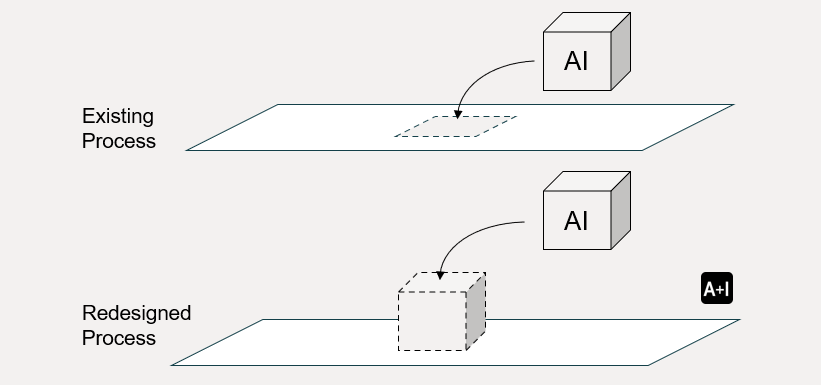
Now you drop AI into a few of those steps. You’ve made a human-shaped process run a little faster. But the shape is still human. You’ve optimised the workaround instead of removing the thing it was working around.
The Trap: a Faster Version of the Wrong Design
There’s an old warning in process design: automate a bad process and all you get is a faster bad process. Automating the steps of a people-shaped workflow does exactly that. You speed up the relay race without asking whether it should be a relay race at all.
History has already run this experiment, and the result is worth knowing.
When factories first got electricity, owners did the obvious thing. They pulled out the big central steam engine and dropped in a big central electric motor. Everything else stayed the same, e.g., the same building, the same overhead shafts and belts carrying power to each machine, the same layout. And the productivity gain was… underwhelming. For years, economists puzzled over why this miraculous new power source barely showed up in the numbers.
The breakthrough came only when a new generation stopped swapping the engine and started redesigning the factory. Electric motors don’t need a central driveshaft. You can give every machine its own small motor. Once you accept that, everything changes. You can lay the factory out around the flow of work instead of around the location of the driveshaft. You can build single-storey plants, light them properly, and move materials logically from one station to the next. Productivity didn’t creep up, it leapt. But this evolution is only for the people who redesigned around the new capability, not the ones who just replaced the engine.
Dropping AI into your existing steps is replacing the engine. The real prize goes to whoever redesigns the factory.
Redesigning around AI’s Actual Capabilities
So what does “redesign around AI” mean in practice? It means designing the process around what your new executor is genuinely good at, not around what your old one was limited to.
AI’s real capabilities are close to the opposite of a human’s. It works in parallel, not one thing at a time. It runs continuously, not in business hours. It handles thousands of cases at once, not one. It doesn’t lose context between sessions, so it doesn’t need the handoff documentation. Switching between tasks costs it almost nothing. It can gather from every system at once instead of checking them in sequence.
Design a process around those properties and it stops looking like a relay race.
Take a typical service request. The people-shaped version is a queue: the request arrives, waits, gets assigned to someone, who gathers information from several systems one at a time, drafts a decision, routes it for approval, waits, and eventually responds. Now redesign it around AI. There is no queue, because every request is picked up the instant it arrives. There is no waiting for a free person, because all requests are handled at once. Information from every system is pulled together immediately. A decision is drafted for every case, continuously, around the clock. The sequential relay collapses into something that runs more like a continuous service than a line of handoffs.
That is a different process, not a faster one. And it can only exist if you were willing to throw away the shape, not just accelerate it.
The Catch: Someone has to be In Charge
Here’s where a lot of “AI transformation” goes wrong in the other direction. Redesigning the process around AI does not mean handing the whole thing to AI and walking away. That’s how you end up with the failures I keep writing about, an agent optimising a target it shouldn’t, an action taken that can’t be undone, and no one accountable when it goes wrong.
The point isn’t that people leave the process. It’s that people move up, i.e., out of execution and into governance.
If AI is going to execute the redesigned process, the human role changes shape completely. People stop being the hands that do each step and become the ones who decide what “good” looks like, set the boundaries the AI operates inside, handle the genuine exceptions the AI flags, and crucially carry the accountability, because an AI cannot. Software is not a legal person; it cannot be responsible for an outcome. A human always has to be.
This is where governing the action, not the agent becomes the operating model for the whole redesign. You let the AI run the reversible, low-consequence majority of the work at full speed. You put human gates on the small number of actions that are consequential or hard to undo. You tier the process by consequence, and you spend your human judgment where it actually matters instead of spreading it thinly across every step. The AI brings the execution. The people bring the governance. Neither half works without the other.
Two Design Questions
So the next time someone proposes fitting AI to a process, notice that they’re usually answering only half the question.
“Which steps can AI do?” is the automation question, and it’s fine as far as it goes. But the transformation question is different, and it comes in two parts. First: “if AI were doing the execution, what would this process look like if we designed it from scratch around what AI is good at?” And second: “where do people need to stand in that new process to govern it, e.g., to set the goals, hold the boundaries, and own the outcome?“
Answer only the first question and you get a faster version of a process built for people who aren’t really running it anymore. Answer only the second and you get careful governance of nothing much. Answer both, and you get the actual revolution: a process shaped around AI execution and human judgment, each doing what it is genuinely best at.
Don’t automate the steps of yesterday’s process. Redesign the process around AI and make sure a person is still holding the wheel.